TASO – The AIDS SUPPORT ORGANISATION

TASO, an indigenous HIV/AIDS organisation was founded in 1987 by Noerine Kaleeba and 15 other colleagues – some of whom have since died of AIDS related illnesses. It was based on people unified by common experiences faced when encountering HIV/AIDS at a time of high stigma, ignorance and discrimination. (Information from the TASO website).

In 1989, I had gone to work in the Royal Borough of Kensington & Chelsea in London, UK, appointed as a specialist social worker for adults – primarily gay men, living with HIV/AIDS. At that time, there was an extraordinary degree of ignorance and discrimination both at a Governmental, public level and at a personal level. AIDS was considered a ‘gay plague’ and there was constant vilification of the community in national newspapers and from the Church, and fear within public services such as hospitals, social services providing home support and amongst funeral directors.

It was largely as a result of that generalised fear and ignorance that the gay community itself organised and established specialist services both within hospitals and the wider community, and was ultimately at the forefront of breaking down stigma when it was finally recognised a few years on that HIV did not discriminate on grounds of sexual orientation. It was after all a virus which could affect gay and straight people alike.

When I resigned from RBK&C in 1992 over the decimation of the specialist service I had been part of setting up for all residents living with or directly affected by HIV/AIDS, I was appointed to the London Borough of Newham as an HIV specialist social worker for adults. In Newham at that time there was a sizeable community of Ugandan refugees living with HIV/AIDS.

My own professional history led me to Uganda first in 1995 and I have been returning on a regular basis ever since: as soon as I learned of its programs TASO seemed to be the project that I wanted to contribute to.

Through a variety of programs TASO contributes to preventing HIV infection, restores hope and improves the quality of life of persons, families and communities affected by HIV infection and disease. It does this through individual and group counselling; through care which provides early diagnosis and treatment of opportunistic infections and importantly it enhances the chance of living positively and dying with dignity. (Extracts from the TASO website)

My personal experience of working with TASO has been to marvel at the consistently high calibre of staff intervention and encouragement of ordinary men and women living with HIV/AIDS – empowering them to live until they die. In 2007 I was privileged to work with TASO staff in the design of a training manual for working with adolescents affected/infected with HIV, encouraging the development of peer support groups run by the youth themselves.

While facilitating a residential workshop for representatives of TASO branches from across the whole of Uganda I was able to spend much time addressing gender inequality which continues to be one of the drivers of the HIV pandemic in Uganda, with an urgently expressed need by the organisation to focus on that issue.

I have delivered direct training to communities on HIV/AIDS awareness, the impact of gender inequality on the spread of HIV infection in Africa and solutions to lessen that impact.

It was from gender training undertaken at the request of Denis Omiat in his village, Ojama in Serere area in 2007, that some young men requested training to enable them to undertake some of the tasks normally associated with women.

A cooking project for youth was successfully set up – run by a core group of five women who designed and ran a six week cookery course for 30 young men of Ojama village.

(Background: The kitchen building constructed for the cookery course)

The course covered basic information on nutrition, purchasing food from the market and encompassed practical tasks that women of the village carry out every day. Fetching water in jerry cans from the well, boiling it to make it safe for drinking; preparing local foods and occasionally supplementing the diet with fish or meat; cooking and serving the food while not neglecting the washing of hands before the meal. Finally, clearing the dishes when everyone has eaten and washing and drying the plates, pots and any crockery used.

That might sound simple!

In Uganda, as in many African societies, it is unheard of for males to perform the above tasks but by breaking down such a gender barrier it is possible to get whole communities to rethink their core value systems and to make choices about how they might change the relationship between men and women.

In the last couple of years of worldwide recession, TASO has seen substantial amounts of its funding withdrawn and has had to re-evaluate some of the ways in which it had been supporting communities living with AIDS. There are some 21 support groups established by the Organisation. The groups are a social network for people of particular localities who are living positively. However, an increasingly important activity of the support groups has been assisting the members to establish sustainable income generating projects. Past funding had enabled TASO to be generous with start up grants to these groups but this money has now largely dried up and the groups have had to become self focussed and self sustaining from the beginning.

Toward the end of my 2010 stay in Uganda I was invited to provide some training to representatives of the 21 support groups. It was suggested to me by one of the TASO coordinators that many of the groups are lacking skills in business management – including record keeping; marketing skills, basic book-keeping and any notion of succession planning.

Once more, I felt my professional skills were going to be stretched laterally if I was to provide something useful in these areas! However, enjoying a challenge, I decided that I would employ my social work skills, my diverse experience, my counselling skills and build on those I currently employ in my professional work as a team leader/middle manager of a project assisting frail aged in Sydney.

Together with a friend and colleague, Rosette Iteko - a Ugandan woman highly qualified in areas of governance and international development - we developed a two day training program that focussed on SWOT analysis, marketing, recording/accounting and accessing funding.

Pictured Above: Some of the 21 support group representatives gathered for the workshop

Pictured Above: No meeting in Uganda is complete without music and dancing!

My good friend Edith proved most adept at this...

While the training was valuable, there was too much material to cover in such a short time and I have undertaken to write a training manual for TASO based on the content covered in the workshop and that their staff will be able to use across the groups they are working with.

TASO annual report for 2008 lists impressive statistics across all its activities – to list a few:

TASO service centres registered 21,270 new clients

Counselled 65,822 individual clients

Provided medical care to 88,274 individual clients

TASO supported 3,015 children in formal education

With funding from different development partners, today TASO has grown into one of the biggest indigenous AIDS service Organizations in Sub-Saharan Africa, having cared for a cumulative number of over 300,000 individuals and their families since its inception. Through its 11 service centers across the country, TASO has now given Anti-retroviral Therapy to over 30,000 people living with HIV/AIDS out of over 100,000 active clients. Since its inception, TASO has trained about twenty-five thousand individuals and organizations in HIV/AIDS management around the world.

For this level of service delivery and to allow for expansion, particularly in the area of development of sustainable income generating projects TASO will depend on increased financial support and reliance on volunteers like myself who work with them for short periods of time.

Dr Denis Omiat


During a 2005 visit I travelled for the first time to North Eastern Uganda and met a rural community there in the district of Soroti. Sponsored by a church community in London, they were undertaking the boring, digging, building and maintenance of a clean water well.

While in the village of Serere, I was introduced to Dr Denis Omiat at the only medical clinic around, and for a couple of days I observed him as he worked. I was very impressed not only by his medical skills and creative, lateral approach to problems, but also by his respectful attitude in communication with his patients.

One morning, while visiting the ward, we paused by the bed of a middle aged man who at time of admission was dying from cerebral malaria. Dr Denis had administered the recommended dose of treatment but saw no improvement in the man's condition. Fearing that he would die he took a decision to infuse a combination of anti-malarial drugs into the patient's blood stream.

Twenty four hours later, the doctor noted a marked improvement and by the time I was introduced to the patient, he was almost ready for discharge. Denis told me he was often in situations where, confronted with critically ill patients, he had to make clinical decisions that did not always conform to written protocols.

Perhaps this is not so unusual in any medical setting, but in a rural clinic in Uganda it seemed a terrific responsibility for the lone practitioner to take – the more so when Denis explained that although known as ‘Doctor’, he in fact was a Clinical Officer – roughly equivalent to a para-medic.

The only son of a single parent, Denis was one of several siblings. His mother is a primary school teacher, a dignified, gentle woman of quiet bearing aged sixty four. She regarded learning as of utmost importance for all her children and I felt admiration for her in somehow putting each of them through secondary and tertiary education.

This image is © Claudia Giampietri from the very interesting blog cgiampietri.wordpress.com

External circumstances interrupted Denis' schooling for one year when he was ten or eleven. Several miles from his home village, the region has been scarred for many years by insurgency, the roots of which are complex and puzzling for a Westerner to understand.

I found a description in an article by Ben Jones from The Guardian, excerpts of which follow.

"If you ask anyone in the Teso region when things got bad they would say that it was "the time of the Karamojong". In 1986 warriors from Karamoja started looting cattle from the Teso region. The raiding began in the north-east spreading gradually south and west towards Soroti, Katine and Kumi. It destroyed what remained of the region's economy.

The raiding involved the burning of huts, the theft of ploughs and hoes, and the looting of stores of grain and flour. Once prosperous homes with more than 100 cows were reduced to ash. Those who could fled to the towns. But most remained in the villages where they had to contend with repeated raids and attacks."

Denis recounted how as a young child, the Karamojong had raided his village repeatedly and he would run into the bush and hide out for days and weeks at a time, afraid to return home until he was sure the raiders had moved on. In total, he spent a year evading the Karamojong,
sometimes running separate from his mother and siblings and uncertain until he found them what their fate had been. On one occasion, coming back to the village from the bush, he found the huts had been burned to the ground and an uncle shot dead.

In Serere, where I first met Denis, he took me to a displaced person's camp on the edge of the town where dire health conditions resulted in malaria, dysentery, HIV/AIDS – all diseases he was dealing with daily in the clinic. He visited the camp regularly, encouraging the impoverished and hungry people to attend the clinic and be tested for malaria for which they could receive free treatment. Denis demonstrated enormous compassion toward people less fortunate than himself, doing so in a quiet, unaffected way that drew people to him.

Denis told me that he had wanted to become an eye specialist, impressed as he had been by the number of preventable eye diseases that abound in the rural areas of Uganda. Alas, this could only be an ambitious dream since he had not had the opportunity to complete a medical degree.

During the time I spent with him, I was beginning to consider the possibility that with a bit of careful financial planning and saving on my part, I might be able to offer him the chance of full time medical training: I was a little naive in thinking that with his clinical officer training and obvious field experience, akin to something like that of a bare-foot doctor, he would be able to enter medical school at least at third year entry!

From London and after further consideration (and a bit of calculation on the 'back of an envelope') I wrote an email to Denis offering to pay his fees should he want to go to medical school.

Some months later, Denis secured a place at Kampala International University (KIU) in the School of Medical Science and not long after, he moved from his village to commence his studies – right back in the first year of a five and half year course.

Now, 2010, he has begun fourth year studying for a Bachelor of Medicine and Bachelor Surgery (MBChB). It has not been easy for me as the costs have escalated and I now pay for his school
fees, accommodation in Halls of Residence (after he experienced an attempted robbery from his rental off campus) and all his required texts. My sister and brother-in-law also contributed the cost of a microscope and one year of tuition fees and I bought a second-hand computer that had to be replaced this year with a new laptop, external modem and the first month of internet connection. Denis too has experienced the hardship of being many hundreds of miles from his home and family and undertaking formal studies, some subjects of which have pushed him to the limits. However, he has passed each year proving his commitment to graduate. I have never doubted his intention once qualified to remain a doctor in Uganda and ultimately my temporary ‘sacrifice’ will mean that 7,500 + individuals will be able to access a qualified, competent medical practitioner.

I felt greatly honoured last November to receive an email from Denis informing me that he and Catherine had named their newly arrived daughter after me. In spite of my suggestion that she need not be given all my family names, she has been formally named Miriam Lois Pollock. Happily for her, she is known by all the family as Baby Po.

Demonstration Chicken Farm (2010)

In 2009 I began planning a project with the Serere Community Development Initiative (SECODEI) to establish a small chicken farm which would demonstrate best practice and sustainable farming methods. It was intended primarily as a template for women and girls to develop sustainable independent businesses.

Like others of my projects the farm would be based in Serere, a village in North-Eastern Uganda approximately 400km from the capital Kampala and with a population of 8000.

$2000AU donated by a generous family in Sydney, friends and relatives provided start-up money covering material and construction costs, the purchase & immunization of 10 hybrid (healthier and more productive) chickens as well as a wider immunization program for some 200 other chickens, ducks, geese & turkeys belonging to local villagers.

Those funds also afforded three practical seminars for community members on successful chicken farming and were given by a local agriculturalist (on top of the initial two given by myself and Dr Denis Omiat.)

DIARY OF THE CHICKEN PROJECT

In the first hour of each waking, Denis and I stand together in the cleared, swept compound space and discuss the plans for beginning the chicken farm project, later strolling across to the site and planning future needs of the birds and the community involvement.

By 10.30 on our first morning in Serere and after an eight hour bumpy car journey from Kampala, about seventeen women and three men have gathered in the 'teaching room' of the partially constructed health clinic that Denis and his wife Catherine are planning to open as the local medical centre and community resource. The group are seated on benches and folding chairs locally hewn from scraps of timber.
A quite long introduction lead in began with a summary to the group as to the purpose of the meeting, followed by prayers and two welcoming songs.The group settled to listen to my prepared talk about chicken farming. I explained that I was not a chicken farmer and all the information I would impart to them had been gained by me from extensive reading – of articles and blog sites I had accessed on the Internet and where possible, drawing on information from Ugandan and other east African country sites. For the next hour and a half, the community group listened with concentration, pausing me from time to time to ask questions.

The group was fully interactive, its members confident and sure of what they hoped for in outcome for this model chicken farm project. Potentially awkward questions about why it was to be built on the land of one person and how the rewards would be dispersed within the whole group, were openly discussed.

Community cohesion is much more apparent in rural communities in Uganda than evident in my everyday, more sophisticated Western society. The song and dance performed for my benefit on this occasion draws me in as the words inform me of what the community is giving to me and I am to receive from them: it is a kind of blessing song and the participants move gracefully and then as the tempo lifts, raise arms and swing their hips, a colourful medley of greens, yellow, reds and blues as the traditional dress of the older women swirls and eddies around them.

Following lunch, the meeting re-convenes and the local parliamentary member arrives on the back of a boda-boda, is introduced all round and gives his approval for the program, promising many financial incentives that none of us believe will materialise. It is when he has again left for some constituency meeting elsewhere, that the group returns to serious planning and time-tabling to ensure the project will be established within the space of 3 weeks.

An active community group member, Modesta, is appointed to be jointly responsible for the day to day running of the farm once the structure is completed and the birds installed: as she lives at some distance from Denis' compound, there is great applause when I announce that I will buy a bike for her daily use, but as an asset for SECODEI.

Our discussion has gone into a detailed account of the needs of the chickens and the likely cost for building the coop and ongoing specialist food for the birds, the deep litter that will be required for the nesting boxes. One man who has been attentive but quiet throughout, raises his hand and says that he will donate the litter as he is a carpenter and has access to wood shavings, a by-product of his work that he would normally sell.

The group claps its approval and then someone else, a forester, volunteers that he will donate a large tree to provide all the timber needed for the chicken coop.

Our first community meeting ends in the late afternoon as the shadows are beginning to lengthen: the group members are smiling, relaxed and evidently excited and happy at the venture about to begin. I am delighted with this beginning – after months of planning from twelve thousand miles away, it suddenly all seems to have come together and be a reality with real potential for the community to acquire new farming skills that could be duplicated not only in this village, but with local adaptation, throughout Uganda at relatively little cost and specifically for the benefit of women and girls.

Osama is to be the builder of our chicken coop: he has had the plans for several weeks now, purchased online by me and sent to Denis long before my arrival in the village. He is more familiar with building houses and the unfinished medical clinic is also his work, but this Western style chicken coop is a challenge to which he good-naturedly rises over coming days.

Before darkness has fallen on that first day, Osama has marked out the floor area for the coop and early the next morning I am woken to the steady sound of a hoe hitting the ground, turning and loosening the earth to establish the boundary for the foundation. (Osama proves to be very hard working for what seems pitifully small reward, plus the occasional flagon of the local brew, Waragi).

I keep detailed records of the project and book-keeping so that I can see at all stages, the exact cost of everything.

By the middle of the third week, I am pleased to note that we are within budget and will have sufficient money to conclude the project with purchase of the bicycle, and a mobile phone for Charles who will remain living in the compound after Denis has returned to university and Catherine, who has taken annual leave, to her clinical officer posting and rented accommodation in Serere town.

There is also money for purchase of the first 10 hybrid chickens that fully feathered and eighteen weeks of age, will be purchased in Kampala, transported to Serere and settled into their new home for four weeks before they begin to lay. Three months of food money and vaccine will also be left available to provide opportunity for the community group to decide how they are going to fund the ongoing project.

I know it'll be a success when I see the effort that everybody puts into the construction. It's back-breaking work, but men and women alike approach it with enthusiasm.

The area around the chicken coop has been completely cleared of weeds and planted with fast growing trees to provide shade: in the interim, the women have built a shade area in the local way – four upright poles and a thatch roof! Wire has been stretched and tightened to fencing poles and topped with barbed wire as added precaution against predators; the walls of the coop are completed and the pitched roof fixed; painting of the structure begins but is not completed until the day after I have left.

Locals comment that the chicken coop is grander than their own homes and I think to myself that if it fails as a chicken project, the coop at least will be put to good use! But, the project is not going to fail: there is too much determination in the group and already, discussion about how to adapt this coop and build cheaper, equally good housing and to expand the number of birds.

MORE PHOTOS FROM THE PROJECT

Working in rural Uganda requires adaptable social-work skills!

Our hard-working team of builders

Community member Helen gives a speech at the close of the project

Celebrating the successful completion of the chicken farm - including (at top) Dr Denis carried aloft mid-dance!

Photos from Uganda trip in 2005

This section contains some pictures and information on my 2005 Uganda trip.

I have known Barungi since 1995 when I met her on my first visit to Uganda. An orphaned girl, her mother having died from an asthma attack, she had been brought up until age 11 in a rural village: obviously intelligent and eager to learn, she moved from the village to live with her uncle John in Kampala and he was able to pay tuition fees enabling her to attend one of the better schools in Uganda. Barungi passed 'A' levels (equivalent to Yr 12) by the time she was 21 having been withdrawn from school on several occasions when there was no money available to pay her school fees.

Barungi was six months pregnant when we met again in 2005: she had previously carried a child full term but lost it during birth when she had to be treated herself for cerebral malaria and the infant was stillborn. The following year, she again became pregnant and carried a child full term.

On that occasion she gave birth to an apparently healthy baby, but the medical team dropped the child on the floor of the delivery room and it died of injuries sustained. When I caught up with Barungi in 2005 she told me she no longer trusted doctors or hospitals and intended to have this baby in the village with traditional birth attendants. I was concerned, because from her history it seemed there may be complications for her during the birth that would not be managed in the village setting.

I was able to fund her to have a safe delivery in a hospital used by wealthier Ugandans and ex- pats and she safely delivered a son. (In 2009, she safely delivered a daughter and has decided that two healthy children will be where she and her partner ‘stop’ with the advice of family planning.)

Barungi is currently in final year, through evening study, of a business degree at Makerere University - she has managed to pay her university fees entirely through savings from her small home based business and with the support of her partner. At age 30, to get to this level of education has not been easy for her but her sheer determination will see her graduate in 2011.

John Bigyemano adopted me as his 'sister' in about 1994 when I was a social worker in London Borough Newham: he is a journalist, long time community activist in consumer affairs, former TV political talk show host/commentator and a real estate agent. I met him in Uganda in 1995 on my first visit and we have become committed friends and 'family' since then!

A special little girl, Moreen

Moreen turned up at John Bigyemano's home with her father when I was staying there in 2005. It was immediately apparent that both were unwell. Her mother had recently died of an AIDS related illness and her father's appearance suggested he may also have the AIDS, although he had not been tested. The child aged five, was well below expected height for her age, and her swollen belly indicated possibility of worm infestation and possibly other illnesses. She was completely apathetic and withdrawn. Her father agreed to be tested for HIV and to have Moreen tested. My contacts with TASO proved invaluable and I was able to get both seen by a doctor and for tests to be undertaken. Sadly, both tested HIV positive - the father with an AIDS diagnosis due to various opportunistic infections and the child also with worms and other worrying indication of opportunistic infection.

This family was indicative of the many thousands seen by TASO: extreme poverty, virtually illiterate, unaware of the implications of HIV other than fear of dying and not linked to clinical services close to their home where they might access AARV's (anti retro-virals). Father and child were linked to a TASO regional service and they started eventually on AARV's. Sadly, he has since died but Moreen, five years on, is alive and improving with regular medication.

Back in 2005, she had no toys at all, had never seen water running from a tap nor taken a shower! Along with another small boy also visiting from a village setting, they experienced a shower for the first time and were initially 'terrified' but then enjoyed it so much they sought showers more than once a day!

Moreen's face tells it all: when given a football, she held onto it for dear life and carried it everywhere with her.

You will find in the posting about TASO and in 'How You Can Help', an indication of the value in donating to the work of TASO or, in supporting completion and operation of the Ojama Health Clinic: TASO provides essential services to men, women and children infected with HIV/AIDS and in addition to providing and administering ARV's has a variety of education programs including youth based programs to help in the prevention of HIV infection. Ojama Health Centre when completed will include a safe maternity delivery suite and excellent pre and post natal care for rural women and their babies. 

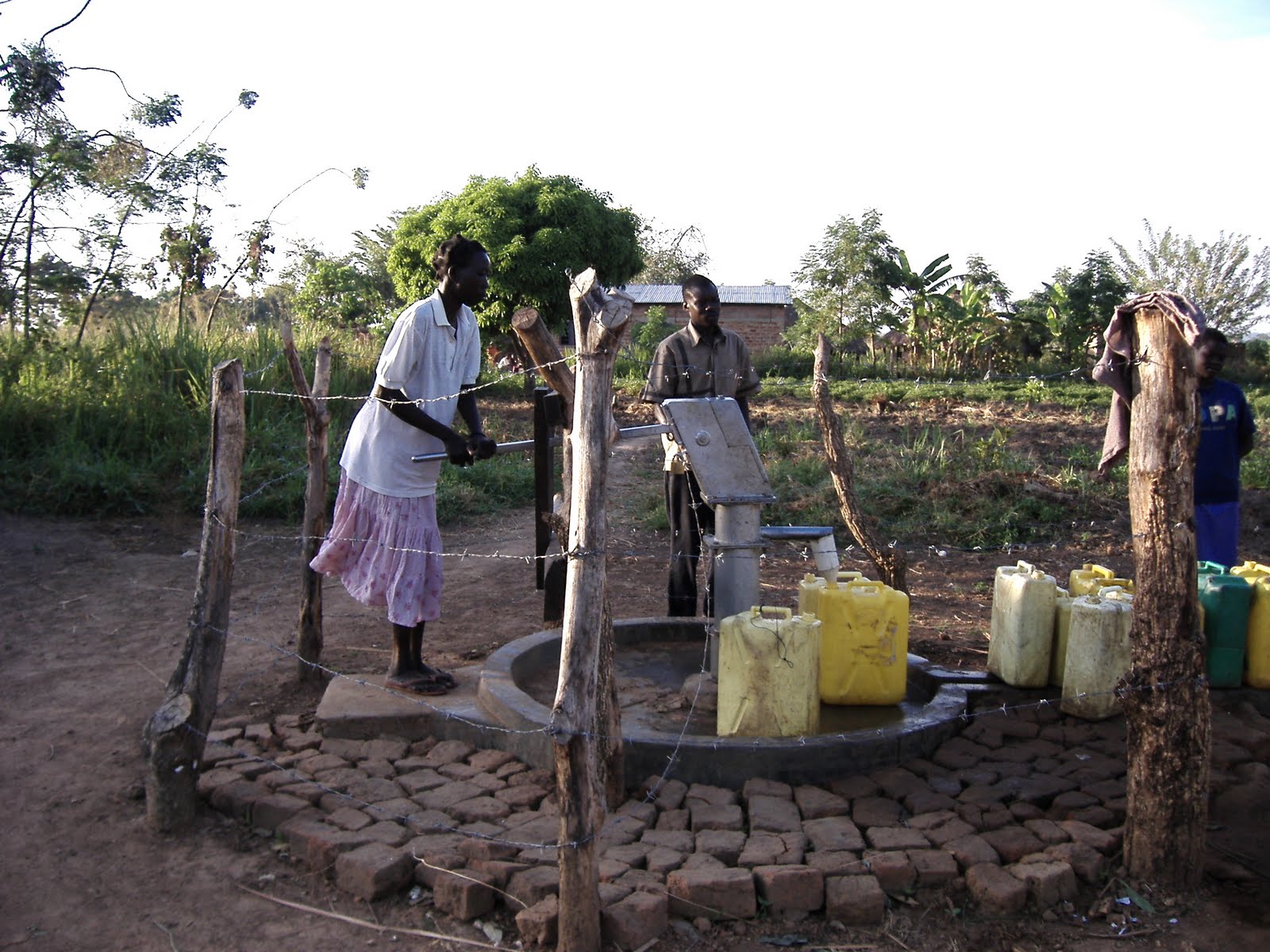
Safe water supply in Serere

Safe water supplies still remain a scarce commodity in rural Uganda: this one, in Serere district, North-Eastern Uganda was financed from a group in the UK. 

Safe drinking supplies not only help inhibit water borne diseases but mean that women and girls (mainly) no longer have to walk several miles, several times a day to draw water from unclean water holes. Fetching water from the safe local wells, helps ensure girls get to school on time each day.

You will find in 'How You Can Help', an approximate estimation of the cost of sinking one well to serve a small community.


While visiting Serere, I met Denis Omiat and some of his extended family. (Denis is the rather earnest young man crouching in the front row in this picture- he had just completed a ward round in the hospital/clinic where he was the (unqualified but amazing) doctor.

Support for orphaned children to complete secondary education

Sherinya was 14 when I met her with her brother John. Both are orphans and have been supported financially for a number of years by a benefactor in the UK who has paid for school fees and books. By 2009, the same benfactor had continued to pay for her university fees and assist her and her brother with a multitude of other daily expenses: I delivered her a computer on my recent visit, gifted by the same generous person: she was by now, in her final semester of a Business degree at Makerere - one of Uganda's leading universities.

Sponsoring a young person to complete education leaves a lasting legacy not only for the individual, but also for the community in which they live. You will find in 'How You Can Help' an indication of the costs involved in supporting tuition fees for a child to complete school, and a young adult to complete tertiary education.